
March 2026
Wordy Quilts at QuiltCon and Sustainability

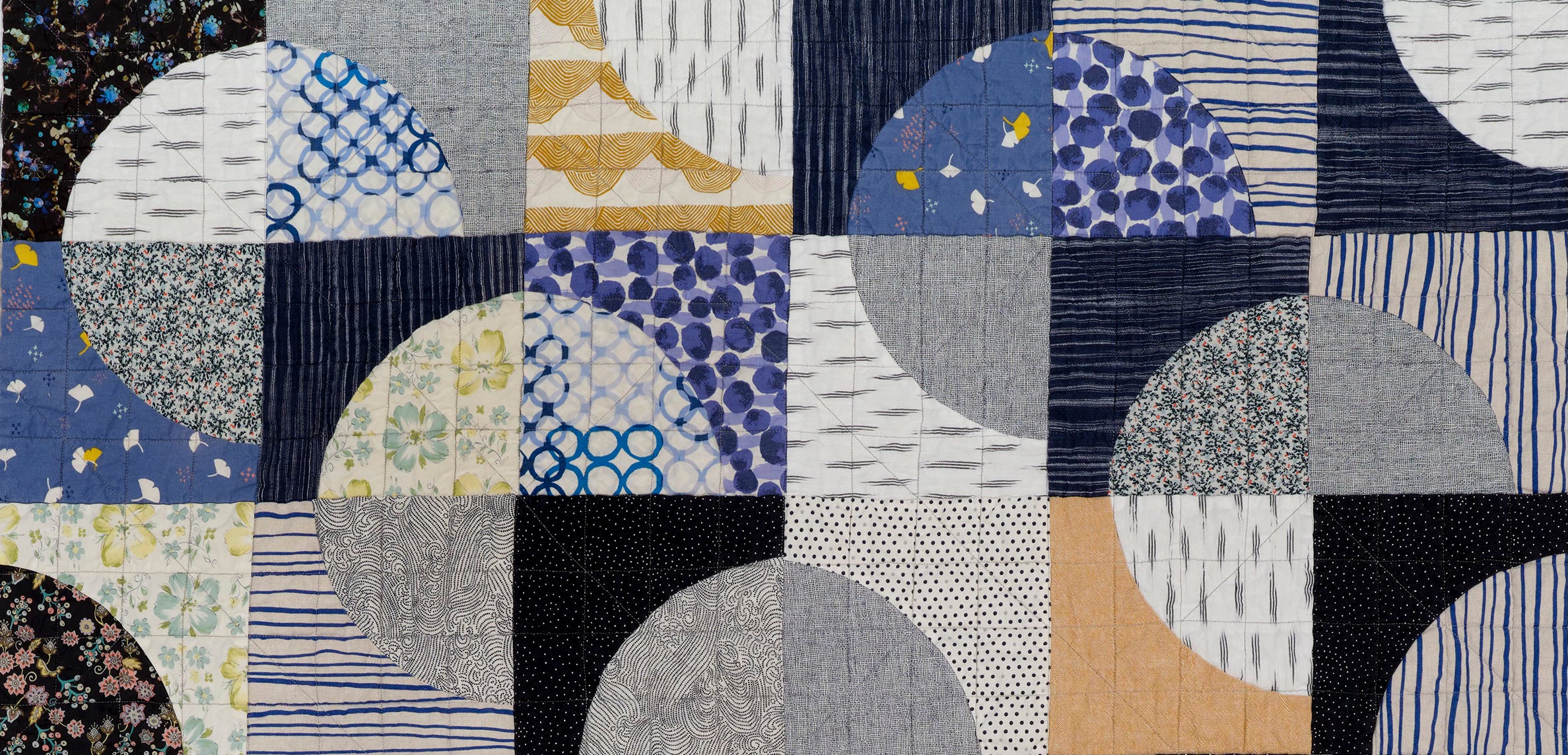
One of the biggest quilt shows in the US wrapped last month. I didn’t attend, but followed along online. While I’ve got some issues with QuiltCon and the Modern Quilt Guild, I do love seeing all the quilts show up in my Instagram feed. I also know that for so many people, it’s a great way to build community. But I’ve also noticed a weird defensiveness around any criticism, almost like “thou shalt not speak ill of QuiltCon” — which is a red flag that things are not all rosy.
For me, the downsides come from an increasingly sclerotic definition of what ‘modern quilting’ is — I’m not even sure something like this can be defined at all but it certainly needs to remain fluid. My other bugaboo is their stubborn insistence on allowing up to four quilts per artist in a show where there is a 75% rejection rate. By cutting down to two quilts per person max (which a lot of shows have already done), many more talented quilters would get to participate and they would put on a show that is a better representation of their growing membership.
This post though is less about the endemic problems of QuiltCon and more about two things in particular: the latest trend in quilts with words on them and the Modern Quilt Guild’s non-stance on sustainability.
Quilts with a lot to say
If you followed along on Instagram, you probably noticed that there were a lot of protest quilts at QuiltCon this year and that’s a fantastic thing. I was really happy to see so many people stepping up and expressing themselves about all what’s happening in our country and the world right now.
That said, I have to admit that for me, simply stitching words on top of a quilt leaves me cold.
(Note: I’m not going to showcase any particular word quilts here because I don’t want to single any quilter out. If you haven’t seen them, they are all over Instagram as well as in the online show linked to below. A word quilt is just one that has a slogan or phrase stitched onto it rather than being purely visual.)
First off, I want to say that I get why people use this approach. It’s a much faster and simpler way to get your message out than coming up with a visual concept. But like signs at a protest march, these quilts are locked into a particular moment in time and I prefer art that has some legs to it: something that evokes emotions through color, texture, and shape that will resonate for years to come.
The quilter Joe Cunningham summed up what I’m feeling so well in his latest newsletter:
. . . I prefer not to give mine a specific message I can put into words; I want to make something rich enough in content to be worth returning to for a long time. Although the news is something I don't want to look at more than I must, it seeps into my thoughts all day and I cannot help responding to it. So, as ever, my current quilt will grow from the dirt of current events.
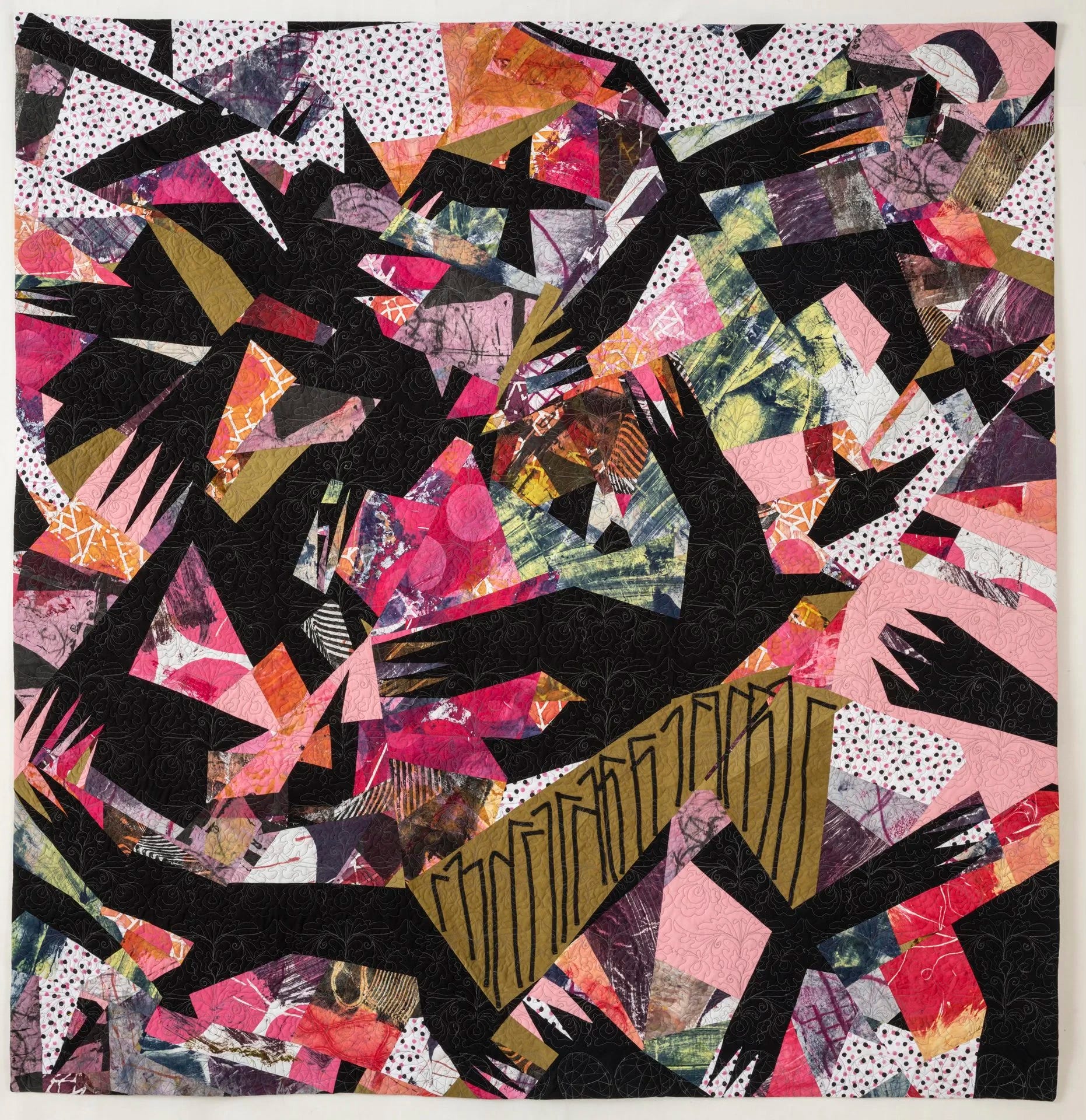
I love this so much: the dirt of current events. Joe’s triptych quilt series Mariupol didn't start out to be about the invasion of Ukraine but as he worked, it became clear that the dirt of that particular current event was coming through. But it isn’t locked into it in the same way it would’ve been if the word “Mariupol” had been appliquéd across the top. By avoiding specificity, this quilt speaks to the chaos inherent in every war.
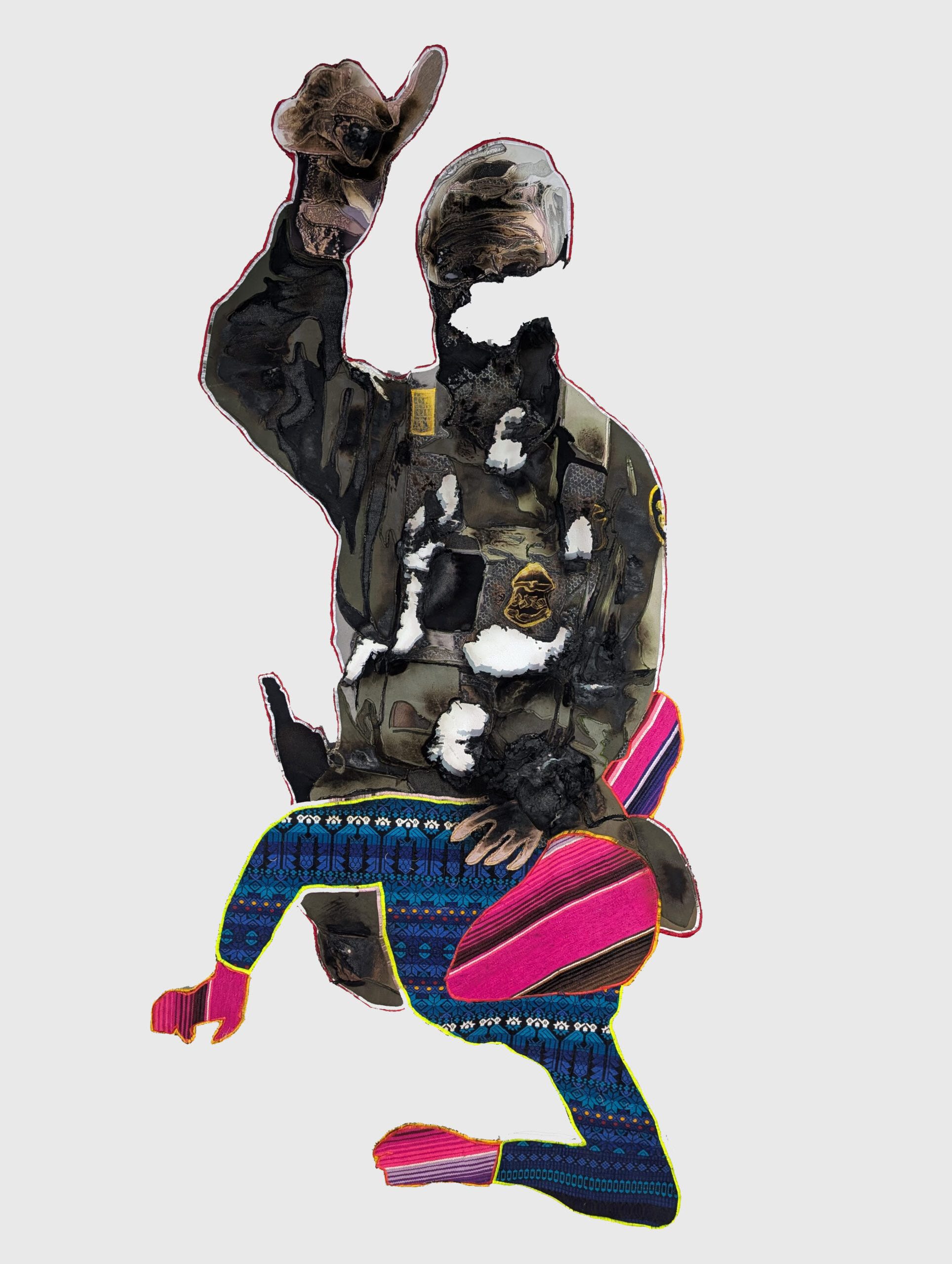
I also think you can respond quickly in a purely visual way too—Fuzzy Mall’s quilt Fire and Ice is incredibly powerful and doesn’t need words to convey its message. The two figures grapple, one brutally dominating the other. It doesn’t need language to tell you that this is an ICE agent and an immigrant—the colors, fabrics, and shapes do the job. Even though this quilt was made in response to current events, it won’t lose its power over time because sadly, we live in a world where this is happening to someone somewhere every second of every day.
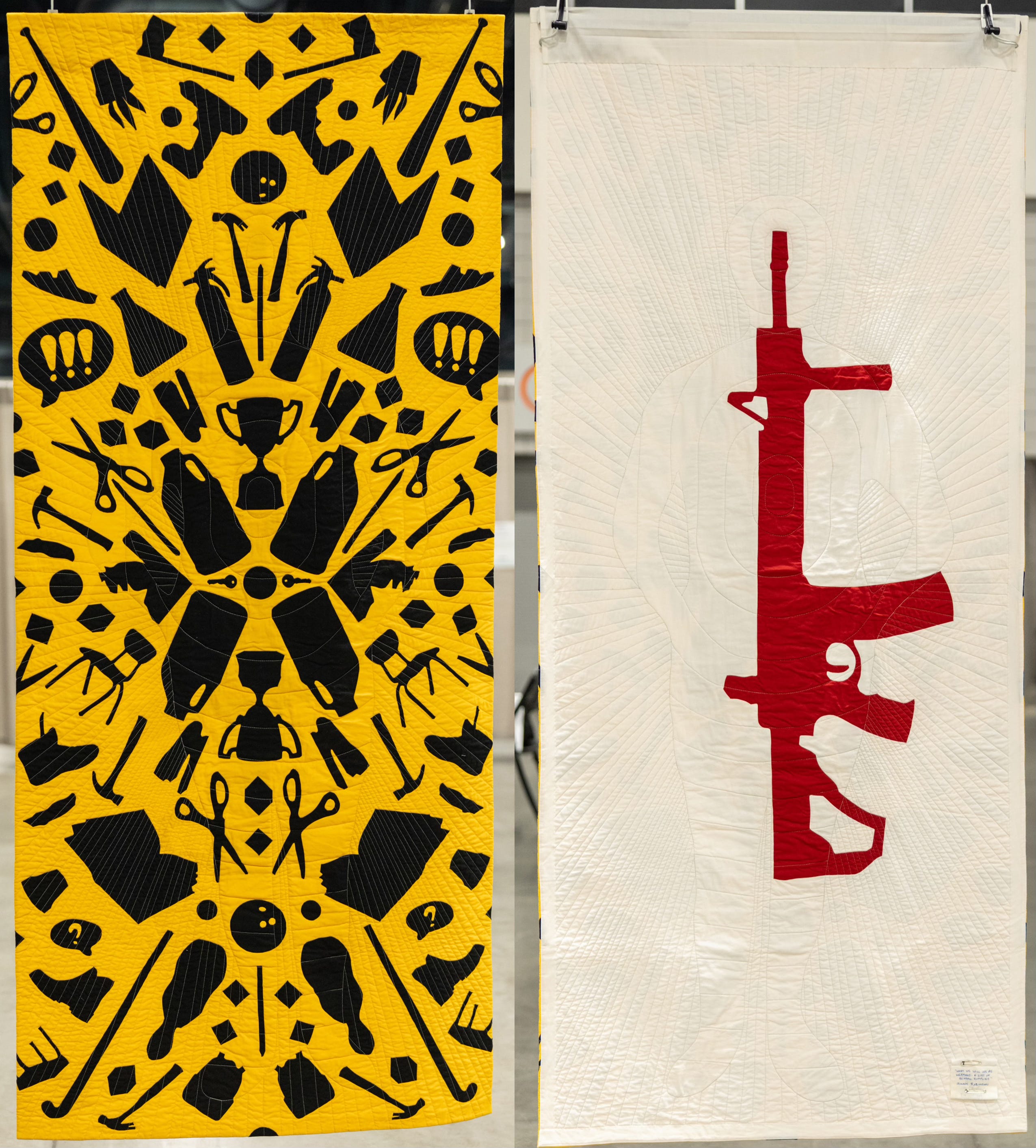
The QuiltCon Best in Show winner from 2024 was another a protest quilt that didn’t need words to break your heart. What We Will Use as Weapons: A List of School Supplies by Ginny Robinson graphically showed us all the things grade school teacher’s could use to protect their students during a school shooting. Did it need the words “what we will use as weapons” on it? No. It did not.
Finally, not to toot my own horn, but I left the visuals up for interpretation on my own protest quilt. Even though to me it’s so clearly a dissolving red cross, many people have had other interpretations: menstruation; the blood of childbirth; anger and rage; motherhood. My goal was to not immediately put people off by stating up front that “this is a quilt about women’s reproductive rights”.
You have to read the artist statement to know this and by then you’ve had a chance to absorb the visual and emotional impact. You’ve had a chance to feel your own feelings in reaction to the visuals rather than ‘reading’, what I, the artist, felt and then reacting to that.
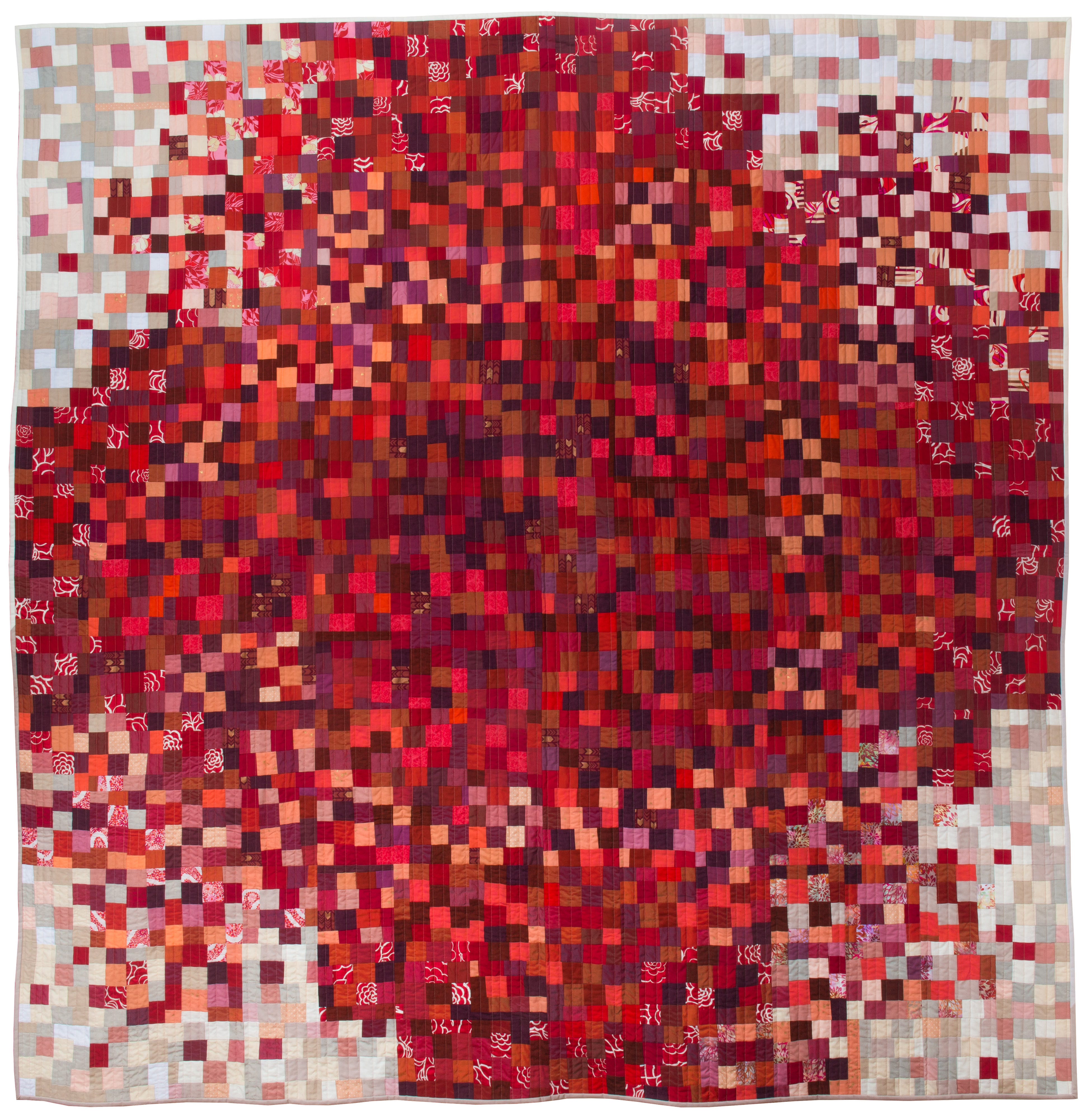
When a quilt relies on a worded message to convey meaning it leaves the viewer with no where else to go. People either resonate with the words or they don’t. And apparently there were a lot of attendees at QuiltCon this year who did not appreciate these messages. I feel like this was a lost opportunity.
I can’t help but wish that the quilts had been more subversive, less reliant on in-your-face messaging, which could’ve possibly drawn people deeper into the work, creating an opening where the quilt’s visuals moved them and then perhaps softened a hardened stance.
So while I love that people are making so many protest quilts, I sincerely hope they will evolve away from being more than just protest signs at a march and into something deeper, less reliant on the written word.
Quilting and Sustainability
The biggest barrier to my attending QuiltCon is the cost. The show is almost always held on the East Coast in either Raleigh, NC or Atlanta, GA, requiring a cross-country flight for those of us on the West Coast. While the hotels connected to the convention centers do offer rooms at a discount, they are still more $250 a night. There are also fees for entry to the show itself with more fees for lectures, classes, and even the keynote speech.
Then of course there are the vendors where many attendees buy fabric, patterns, notions, and even machines. Quilting is big business and quilt shows (and all the big ones are like this) are deeply enmeshed with the rest of the industry.
The show is the draw, but the sales are the point.
So it was no surprise to me when my friend Radha of Sewing Through Fog wrote in her last newsletter about how she tried to sponsor a sustainability prize at QuiltCon this year and was rejected. She not only offered to sponsor the prize itself with a cash award but also offered up her time and expertise to help make it a success. She’s worked for years in the garment industry and knows a lot about the mind-boggling amount of waste that industry creates and ways to ameliorate it. But she was turned down by the Modern Quilt Guild. Why would they reject this idea?
I believe it’s because the Modern Quilt Guild is an integral part of the billion dollar quilting business and anything that encourages quilters to use repurposed materials has the potential to be a problem for their sponsors and vendors. Sure they show many quilts that use recycled materials but it’s not a stand-alone category and there is no judging based solely on this criteria. (Side note: the best in show this year went to a quilt made from recycled jeans which was a nice nod to sustainability and I give the judges credit for that.)
While the MQG is clearly not into having a sustainability prize, they do run a special exhibit every year that is sponsored by Windham Fabrics. The palette is chosen by the keynote speaker in advance and the entries are often quite stunning. I don’t have an issue with it per se but I do see it as an example of how QuiltCon and their sponsors and vendors are linked together in an eco-system: both want you to buy the fabric.
Quilters often amass shocking quantities of fabric. It’s even referred to as a ‘stash’ — like preppers prepping for some future calamity where all the fabric in the world has suddenly disappeared. For many, buying fabric is a hobby unto itself. Like collectors of any genre, they’ll buy up all the color ways and designs by designers they love. There often isn’t any specific plan to use it, just having it is the point. Friends sometime send me links to the sales that pop up after a quilter’s death. Hundreds and hundreds of yards of unused fabric spread out on folding tables. It’s sad in many ways.
I also believe that all this fabric buying possibly leaves people feeling guilty deep down. They know they’re spending thousands of dollars a year on stuff that they will probably never use. So a major quilt show highlighting sustainability over purchased fabric is likely to make a lot of its attendees feel bad about their own fabric buying habits and no way do they want to do that.
My friend Radha took the rejection from MQG and turned it around into something really fun. She created a gallery on her website of quilts that didn’t get into a quilt show, Off the Grid, and is sponsoring two prizes: one is for the Best Use of Repurposed Materials and the other a Viewer’s Choice award for the best protest quilt with the money going to a nonprofit picked by the winner. You can check it out at the link above. It’s well worth your time. (Full disclosure that there three of my quilts in the show)
And to help people consciously uncouple from their fabric stashes, Radha also runs a resale site for fabric called Feel Good Fibers, a destash online marketplace where you can sell your unused and no-longer-wanted yardage.
Of course, you can always just give it away or swap it. Many quilt guilds have a free table at every meeting and my local fashion school holds a fabric swap each year. The amount of free fabric I came home with made me giddy. It would have cost hundreds of dollars to purchase and I’ve used most of it already in quilts. I can’t wait for it to happen again this year. I have a bunch of yardage to contribute and in return, I’ll have a stack of new-to-me cottons and linens to inspire yet more quilts.
Participating in the quilt industry is completely optional.
So with my crabby attitude, will I ever attend QuiltCon? I can’t say. Right now it feels like no, but that could change. Especially if the show grows and evolves into something that feels like a better representation of the full spectrum of modern quilting and quilters.
In the Studio
Things have been quiet in the sewing room these days. The “dirt of current events” has been accumulating while my creativity has been in a fallow state.
To keep my hands busy, I’ve been finishing quilts that were almost done.
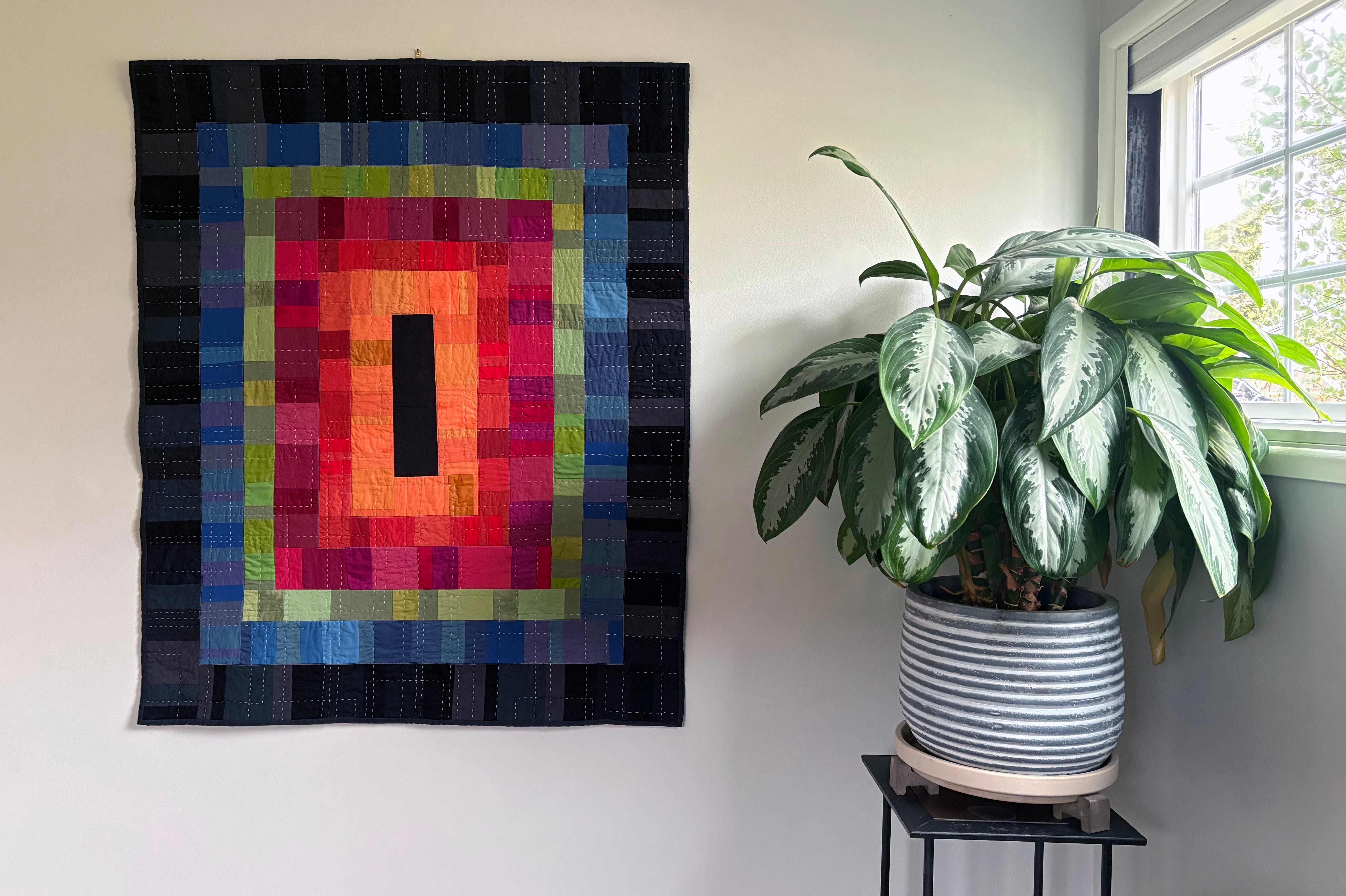
This log cabin quilt still has no name but something about a void? It’ll come to me eventually, I’m sure. I did a bunch of hand quilting on it and am pretty happy with how it came out. It also has some machine quilting around the rectangles and even though it feels a little insane, I’m contemplating picking that out. I no longer fear unpicking machine quilting, I’ve had to do it so many times already, and I think it could be nicer to have the piece entirely quilted by hand.
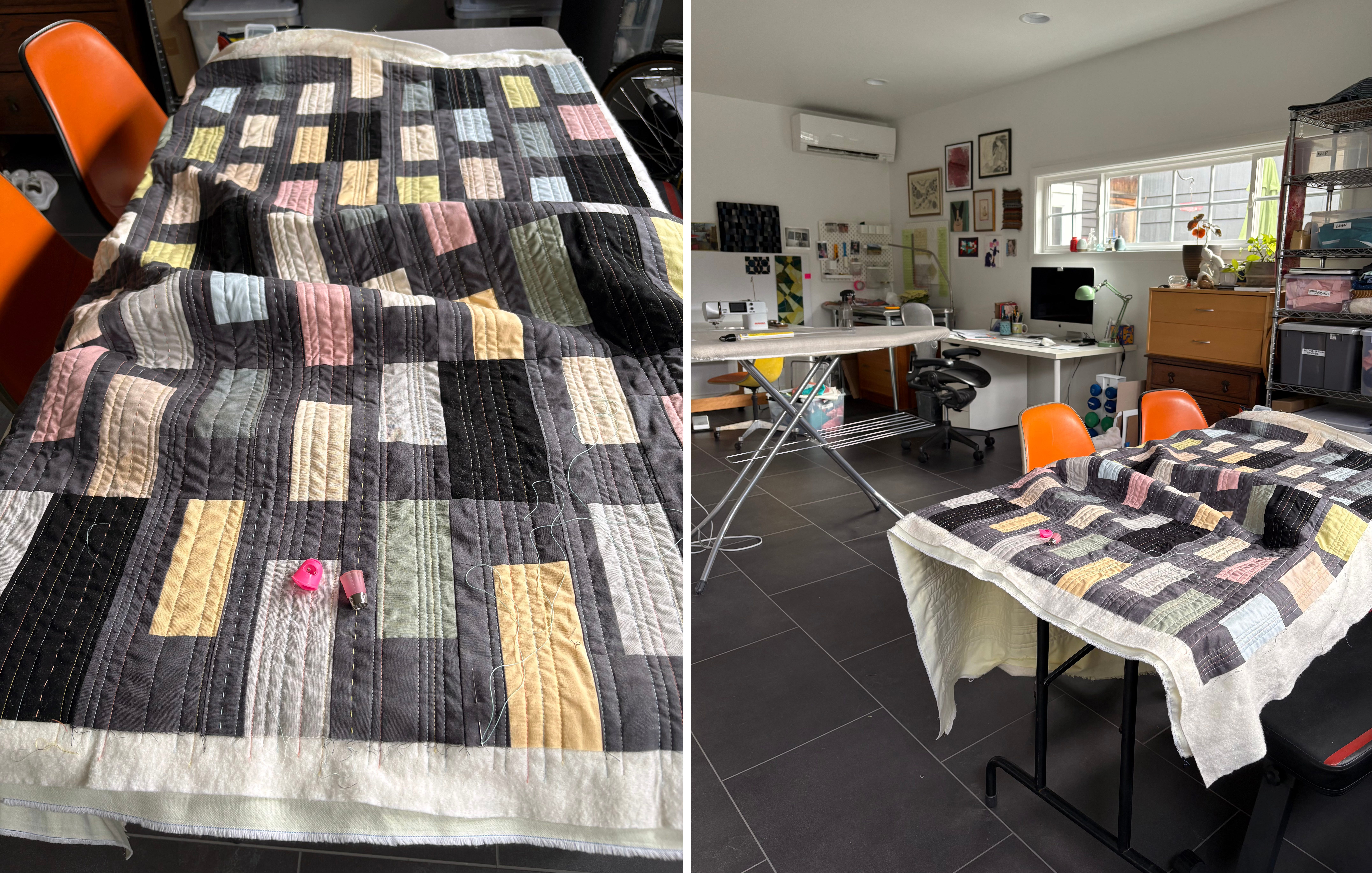
I’m also finishing this quilt. It features both machine quilting and hand quilting and in this case, I really like both. It’s a cheerful little quilt despite being mostly black. It reminds me of Good ‘n’ Plenty.
I also opened up my studio space by moving a shelf against a wall and now I have enough space to have a quilting table set up permanently. Things evolve and thank goodness for that.
I hope spring brings you renewed energy and creativity, and that you can get actual dirt on your hands instead of current event ‘dirt’ by planting something in the ground. I’ve already got my seed order in.
Keep on keeping on 🐸,

If you’d like to support my work, you can do so by:
Liking this post so Substack shares it;
Leaving a comment (I always answer them);
Sharing it by email or on social media (including here);
Signing up for a paid subscription;
or by buying me a coffee.
I have this exact complaint about "protest poetry." Being so direct in messaging is cathartic, but it puts a fence around art and then art can't go out into the world and do more work than you even expected. It can't transcend time, either, and becomes a historical artifact quickly.
Processing rage and grief is deeply important and there's a place for it, but it doesn't automatically produce good art.
I have a stash - all old clothes from my family that so far have become four ‘improv’ quilts. I have eight laundry bags full! I’ve been saving them for years and now have the time to make but wonder if I’ll ever get through them all ….