
June 2025
political quilts // going to the show // a hand quilting rescue

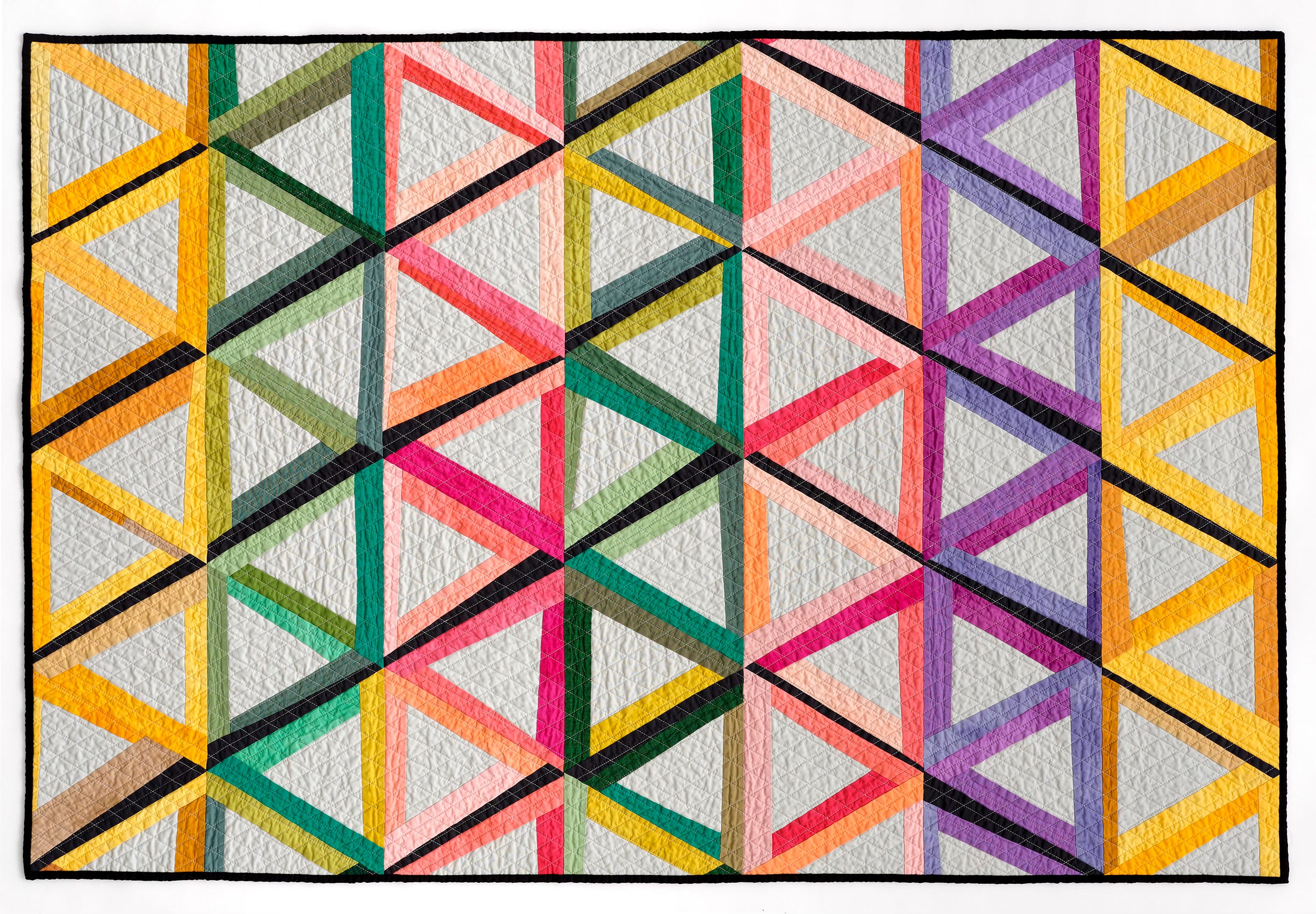
Earlier this month I wrote about my quilt that was banned by the American Quilter’s Society for its subject matter—women’s reproductive rights. It created a bit of a stir! A big thank you to everyone who took the time to leave a comment and restack the post. The more people hear about these cowardly acts of senseless censorship the better.
A common theme I’ve seen in many comments sections—mostly on other social media sites like Facebook—is a desire for quilts and quilt shows to “stay nice”, without any hint of discord. But quilting has always had a political side and been an outlet for women to express their beliefs and viewpoints. A case in point is the ‘cradle quilt’ shown below, made in 1836 by Lydia Maria Child, titled Cherished Possessions (thank you to the thoughtful commenter who alerted me to its existence.)
It’s a simple design, a pattern called the Evening Star. But it contains a bold and courageous poem by Elizabeth Margaret Chandler in it’s center square:
Mother! when around your child / You clasp your arms in love, / And when with grateful joy you raise / Your eyes to God above,-/ Think of the negro mother, when / Her child is torn away, / Sold for a little slave-oh then / For that poor mother pray!
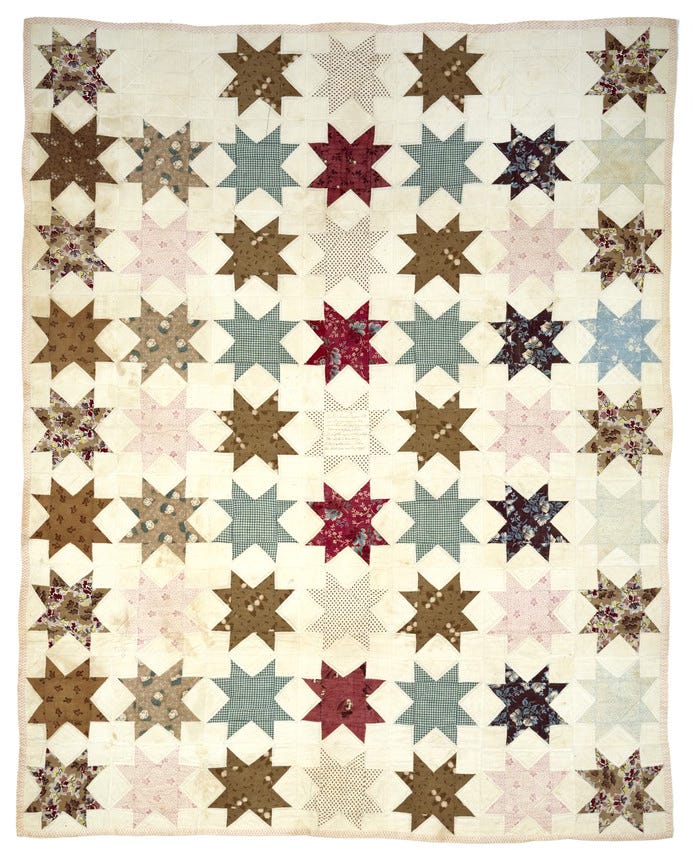
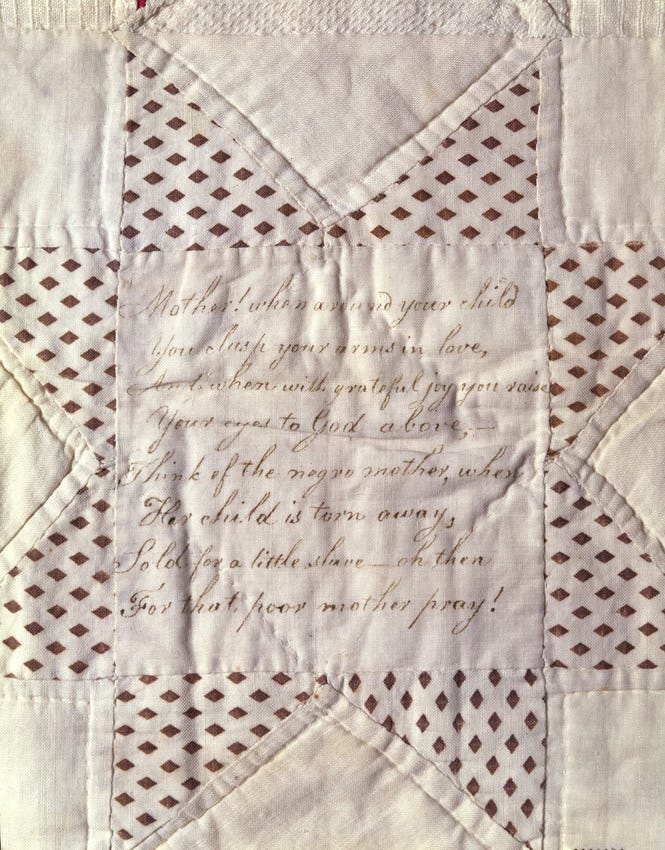
It’s asking us as mothers, as women, to see the pain of an enslaved woman as the same as our own, which was a radical stance against the status quo back in 1836. The quilter was an active abolitionist and she didn’t demure when it came to making a quilt with a statement. Many people would have seen this as an outrageous affront to their belief system and way of life. She did it anyway.
Sadly, her message is still one we need to hear today with ICE agents ripping families apart, taking newborns and small children away from their mothers. With detaining and deporting people without due process, sending them to horrific prisons overseas. The fight against “othering” people who look or love differently is as urgent today as the anti-slavery movement was then. We must keep speaking out about it, in any way we can, especially in our textile art.
I wanted to share this quilt from so long ago as an answer to everyone who wants quilting to just be pretty, to be only about pleasant subjects. It’s pure fantasy to think that women haven’t been expressing their true selves all along with their needles and thread. Keep making political quilts! We need them now. History will need them later.
Here’s a little more background about this quilt from the Historic New England site:
The January 2, 1837, issue of The Liberator, Boston's abolitionist newspaper, described articles that had been for sale at a recent Anti-Slavery Fair. Included was a description of this quilt, made of patchwork in small stars and a transcription of the poem in its center. The Anti-Slavery Fair, held in December 1836, was the third annual fair organized by the Boston Female Anti-Slavery Society, a group founded early in the 1830s to fight for immediate emancipation. Among many of this group's activities was the organization of annual Anti-Slavery Fairs. The fairs were intended to raise awareness of the abolitionists' cause, but they also became astonishingly successful fund-raisers.
Studio Notes
Quilts in Shows


I just found out that Bloom—a quilt that’s been turned down 3x already from other quilt shows—is headed to the Houston International Quilt Festival in October.
I was surprised and delighted! I’d entered two quilts and the one I thought would get in did not—which goes to show, you never know what will resonate so you should always enter if you can. It always comes down to the jurors and the kind of show they’re building.
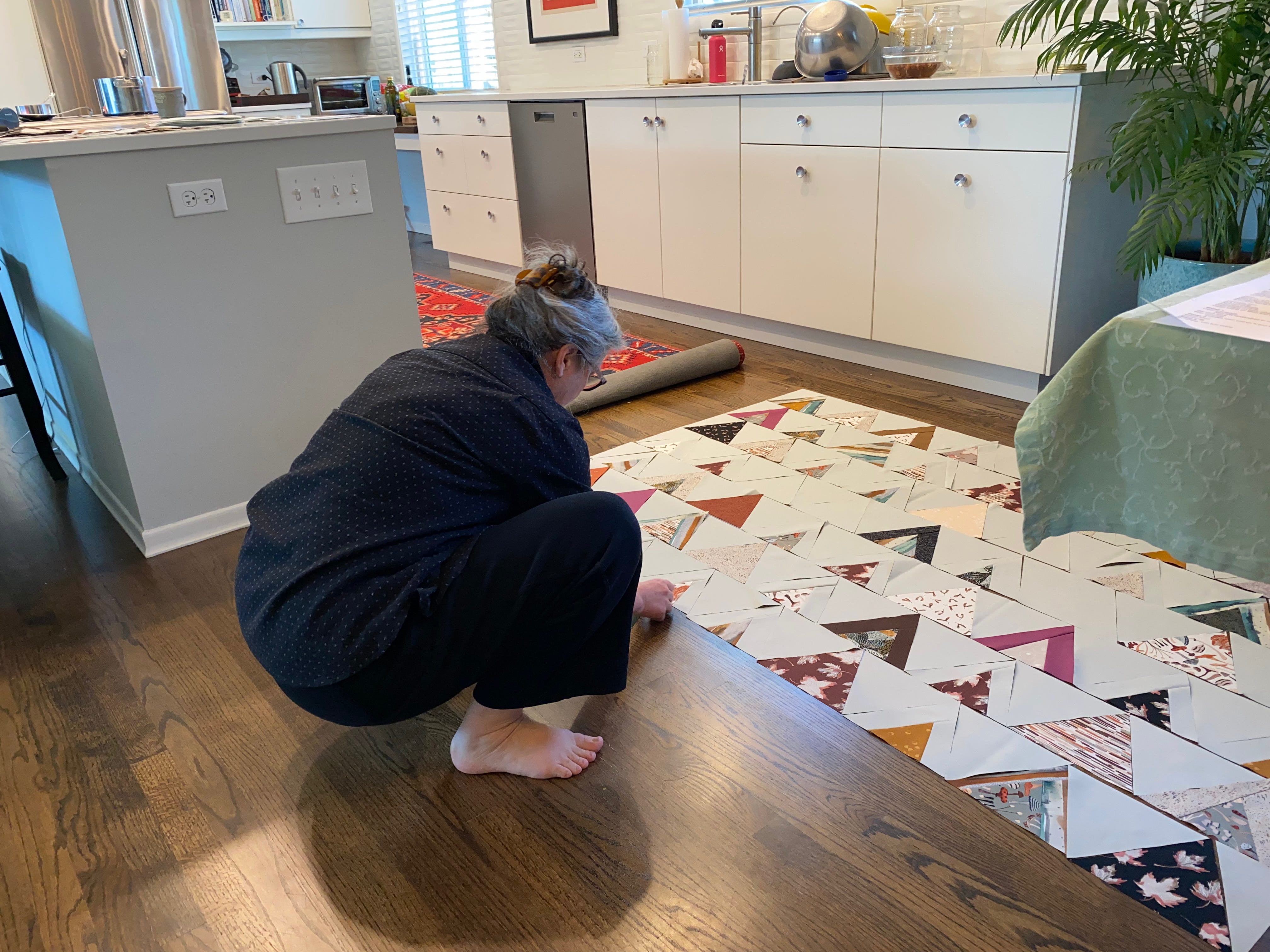
Bloom is a scrap quilt. I had a bunch of greenish-gray triangles in my scrap bin that I’d painstakingly cut out years ago, back when I was still pretending I could be a precise quilter. I’d cut out all the pieces, arranged it, and then bailed when it came time to sew it together. Maintaining the points was too finicky for me and I found that I just couldn’t muster up enough interest to make them perfect. Shortly afterwards I stopped using patterns entirely, opting for my own improv designs.
But those triangles were still lurking around and didn’t want to waste them, so I added some brightly-colored log cabin-style piecing using the wonderful mottled solids from Marcia Derse, letting them morph from perfect into something more fluid. I found it to be a much more interesting process overall.
I’m so happy it gets to go out in the world and be seen!
The Artist Statement
I got curious about triangles and how they play with line, how bright colors combine with dull, how the resulting blocks intersect and create movement in an otherwise static composition. Bloom is a study of control and chaos, much in the same way a formal rose garden is both linear and untamed.
Hand-quilting
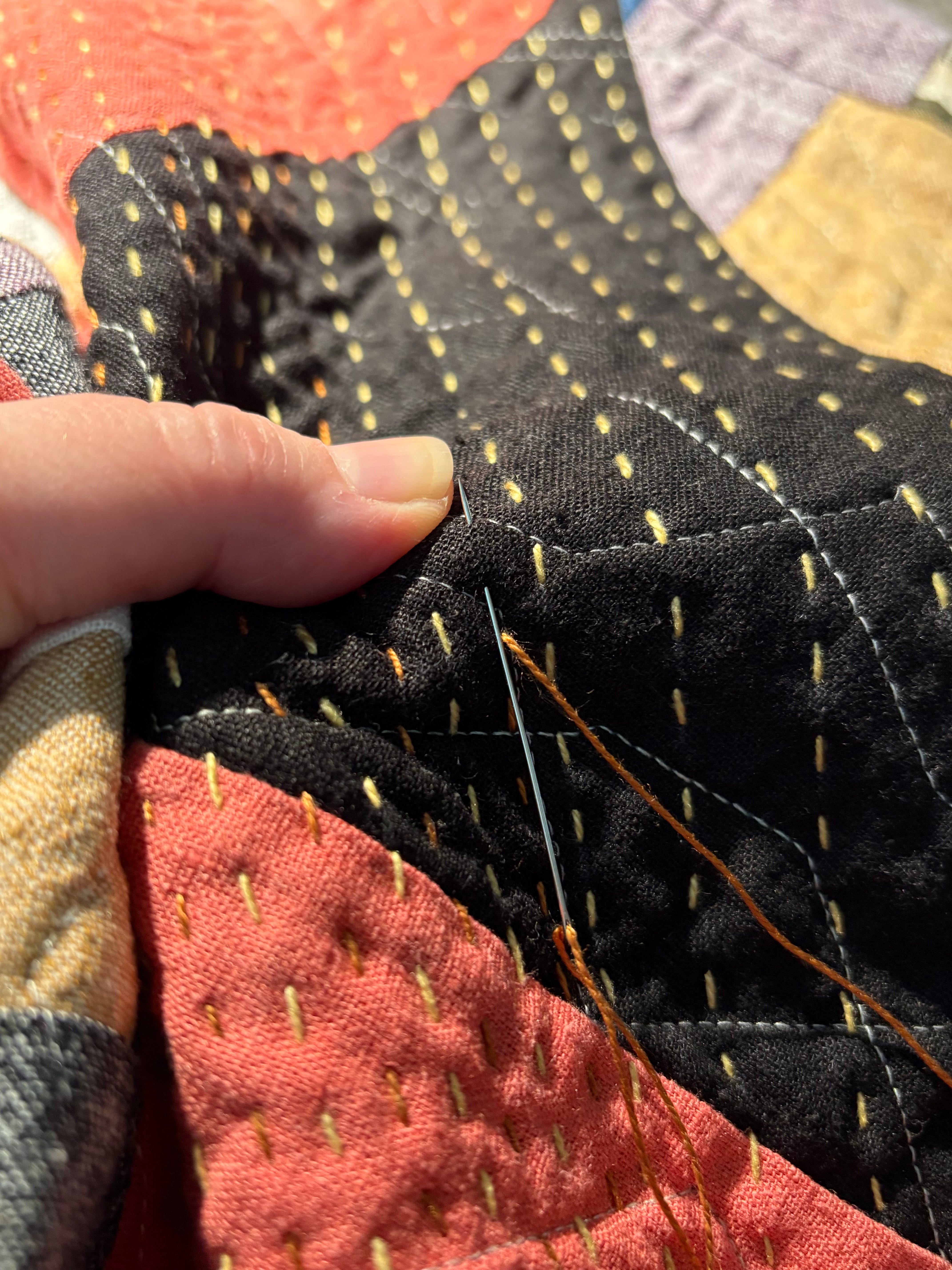
This month also found me spending many happy hours on the couch hand-stitching an old WIP while watching Bette Davis movies. It was the perfect escape from Clownmaggedon.
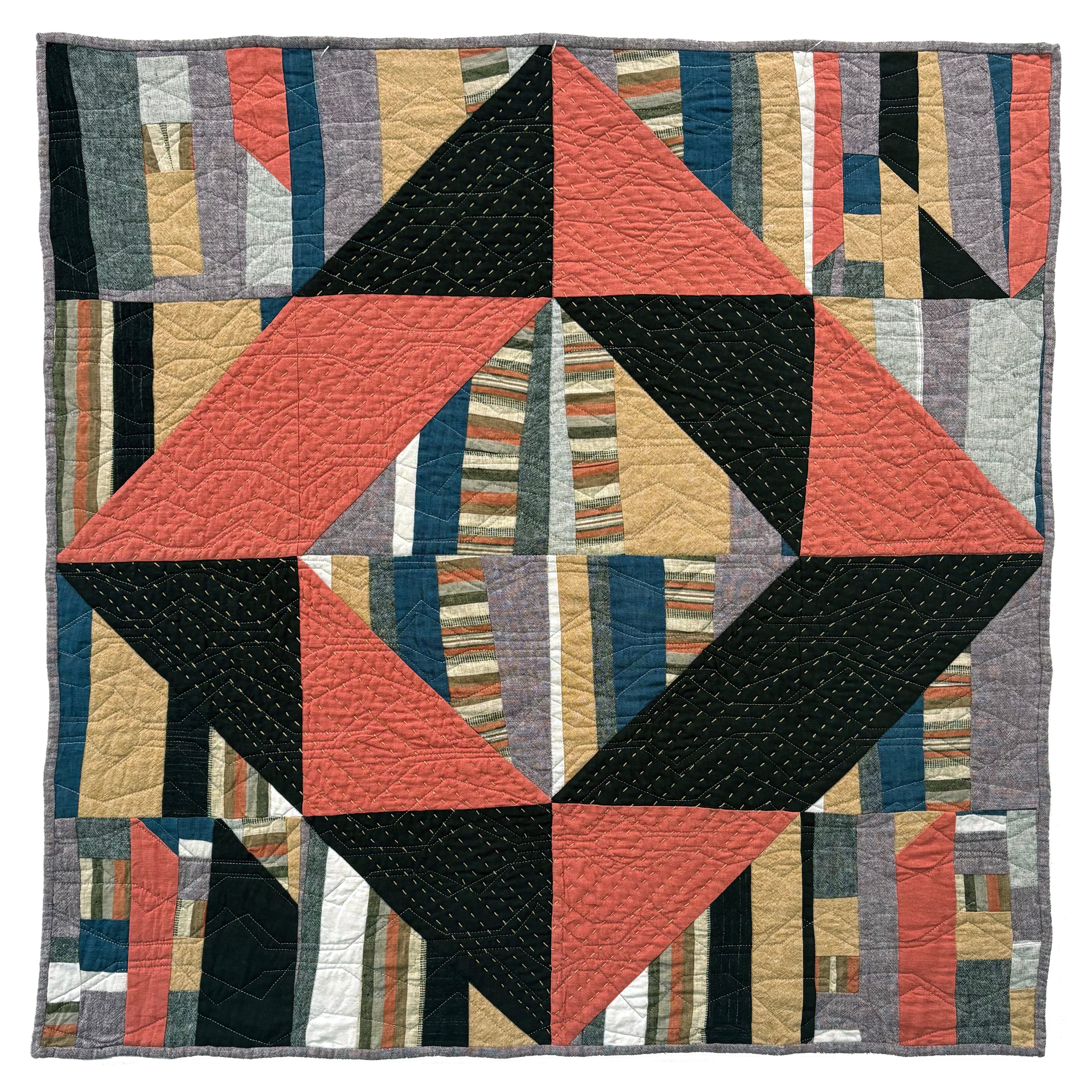
I’d come across this abandoned quilt while rooting through old pieces to cut up and turn into storage totes. It was already machine-quilted but it felt somehow unfinished. I decided that what it really needed was some hand-stitching.
The obvious place was the center diamond. I’ve learned the hard way that hand-stitching on busy patterns or piecing isn’t worth the trouble. It gets lost in the visual chaos and all of your hard work goes unnoticed. I wanted something simple, just straight line stitching in a coordinating color. I drew guide lines and proceeded section by section, rather than continuing all the way round for each row.
Once the gold rows were done I thought: “It needs more!” I was really enjoying watching Bette Davis do her glorious thing—so much so that I didn’t want it to end. So I stitched an orange row between the gold rows. But this time, since I was eye-balling it using the previous stitched lines as a guide, I figured I could go all the way round the center diamond on each row. Round and round and round I went while Bette thesp’d her way through some pretty thin plot lines. HBO/MAX has a lot of her movies available right now but not many of the really good ones. Now, Voyager is the exception. I adore that movie.
I’m one of those casual quilters who doesn’t use a hoop or a frame: the quilt sits crumpled in my lap. When stitching straight across, edge to edge, I’ve never had any issues with this relaxed method. But on this quilt, no such luck. Only once it was done and laid out flat, did I see that the whole center panel puffed up like a 3D topographical map.


I actually laughed when I saw it.
It took a moment or two—and a text or three to a friend with way more experience in hand-quilting than I do—to figure out it was the orange-colored rounds that were the culprit. I’d stitched them in a sort of circle which was cinching the center inwards as I went. So I ripped them out.
It was still a bit puffy, so I tried something else I’ve never done before: I blocked it. I’m used to blocking knitting because it’s the secret sauce that melds all the stitches into a cohesive whole and I’ve heard about other quilters blocking their quilts, but mine are usually so large I can’t imagine where I would lay them out to dry. This one was small though and I had nothing to lose.


After running it through the wash, I got out my Knit Picks Blocking Mats and stretched it flat, pinning around the edges. And it worked! Flat as a pancake now. Perhaps a touch too flat? It’s missing some of the crinkle texture we all love, but at least there’s no more center lumps.
Out and About
Disaster Club
We live in an earthquake zone here in the PNW, with ‘the big one’ having been predicted for years, so my neighborhood thought it a good idea to get a little better prepared. It’s widely assumed that if it happens, it will take 3+ weeks for outside help to arrive, which is pretty sobering.
Climate change is also fully upon us. Most of us will experience some sort of natural disaster where we live. Here in the PNW, besides earthquakes, we’re at risk for wildfires (no one is fooling themselves into thinking urban areas can’t burn after LA and Hawaii), ice storms (we get bad ones with sustained power outages), and extreme heat (it hit 116 degrees a few summers ago).
Any of these situations can be managed better with neighbors looking out for one another. There’s some really good information online that we’ve been accessing on how to collect enough food and water, put together ‘go-bags’, and how to handle sanitation—which is a really big deal when there’s no functioning sewer system or city water (this happens a lot with hurricanes too). Humans produce a daunting amount of poop over the span of a week or two and no, you can’t just bury it (it’s a simple bucket system that anyone can set up).
Our neighborhood crew has already set up a group text thread, collated skill sets, made a list of who has what equipment on hand, chosen a central gathering spot, and worked out other details, all of which means we have a better chance of surviving whatever comes our way.
We also know that a strong neighborhood support system is not just helpful in natural disasters, but also in the kinds of everyday situations where people might need a helping hand. Things like sickness, job loss, and other unexpected emergencies happen to everyone. The closer knit a neighborhood is, the safer everyone will be. Our monthly pot lucks are a chance to hang out and really get to know one another beyond just exchanging hellos on the street. The topic that brings us together may be earthquake prep, but we’re building something here that goes way beyond that.
Part of the inspiration for our Disaster Club was reading Rebecca Solnit’s A Paradise Built in Hell. If you haven’t read it yet, I highly recommend it. It gave me hope that humans can, and do come together for mutual aid during stressful times.
_____
Well that’s it for June. Just a lot of me trying for a bit of calm in an otherwise crazy month. Thanks so much for reading! I love hearing from you, so please leave me a comment or ask me a question—I may not have the answer but I always have lots of opinions!
Have a scrappy day,

When I read your posts, I feel like I'm listening to a long time friend. I wish you were my neighbor! (And not just because you'd save my butt in a catastrophe, though that helps! 😂)
I made some improvisational quilted placemats many years ago and it was fun to create them. Currently I’m quilting a Sunbonnet Sue top my grandmother pieced about 50 years ago. Totally not my aesthetic but I’m
Making it so (sew) by quilting poetry and words and Antiracist reflections into the blank fields around each girl. So, yeah—political.